| Editor | R. Engelbach |
| First Written | 1930 |
| Genre | History |
| Origin | Egypt |
| Publisher | Dover |
| My Copy | cheap paperback |
| First Read | January 20, 2026 |
Ancient Egyptian Construction and Architecture
Notes
This blows my mind: just like some New World cultures had toys with wheels but never used wheels for actual transport, the Ancient Egyptians also occasionally had wheels on specific tools (including a ladder??) and later chariots - but never used them to MOVE anything, even when building monuments. The authors' conclusion is that the cultural focus on the Nile made them too boat-brained to bother with anything else, which is why they made SLEDS to move giant rocks.
Talking this over with BNB crystalized a conspiracy theory I hold: we haven't yet discovered all the Simple Machines. There's more out there, and it's going to look really obvious in retrospect.
Talking this over with BNB crystalized a conspiracy theory I hold: we haven't yet discovered all the Simple Machines. There's more out there, and it's going to look really obvious in retrospect.
Noted on January 22, 2026
Also a thing I've wondered forever: how did Egyptians carve hard stones like granite before the acquisition of tool steel? Could copper chisels really do this? Clarke & Engelbach say that they would take chunks of even harder stones and strike those with hammers in order to serve. I had never thought of this possibility but it seems obvious in retrospect.
Noted on January 20, 2026
A small but striking observation: the author goes into great detail trying to figure out how the Egyptians moved large blocks of stone downriver on their boats, using tomb/palace paintings as references. He deduces a lot, but a few things just don’t make any sense as drawn. He concludes with: on the other hand, we don’t have to assume that tomb painters are experts on boats.
Noted on January 20, 2026
Also, the introduction is a model that I would like to steal one day for a fiction book that pretends to be a dry academic work. They're investigating how the Egyptians built things, and the introduction notes how one of the authors died during the editing process. I'll quote it.
Noted on January 20, 2026
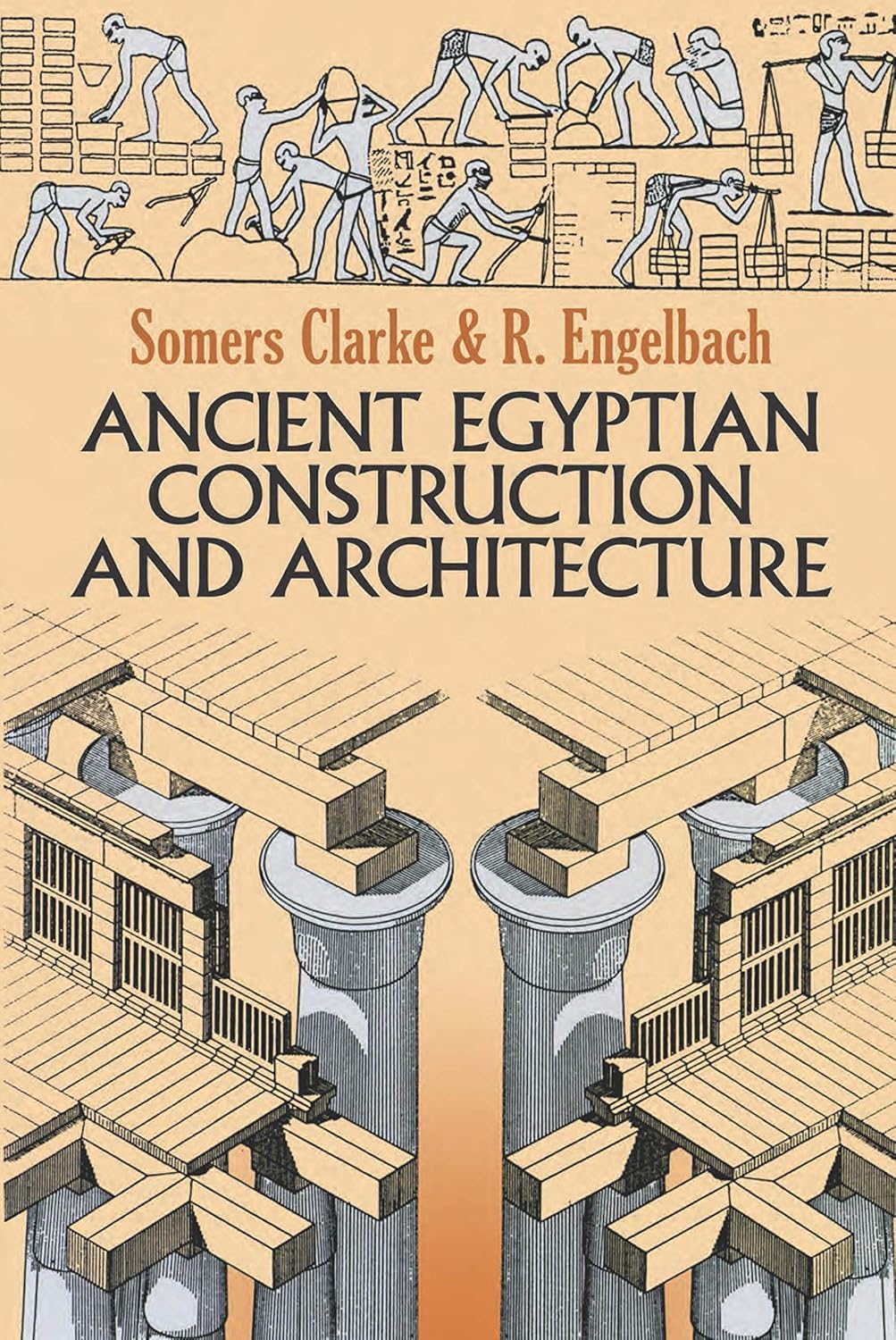
This is a nonfiction book exploring construction methods of the Ancient Egyptians. Yes, they built cool things but... how? How did they quarry the stone, and move it to site, and dress the blocks, and build foundations, etc etc? It's very dry but fascinating, and the Dover edition here is surprisingly full of great illustrations.
Noted on January 20, 2026
Quotes
For instance, it must be realized that the stone quarries were not open to the use of every one, at any rate until late times. The Egyptian world at large appears not to have been permitted to build with stone except in a very restricted manner. The quarrying and working-up of the material seem to have been in the hands of the state. It was natural, therefore, that when methods of work had once been established, the tendency to a hide-bound system, common to all bureaucracies, should develop itself and become crystallized-so thoroughly crystallized that we see, in Egypt, the same things done in the same way from the earliest dynasties down to the period of the Roman occupation, a matter of some 3,500 years.Quoted on January 20, 2026
The purpose of this volume is to discuss some of the problems incident to the construction of a stone building in ancient Egypt. The material has been drawn partly from the architectural notes made during the past thirty years by the late Mr. Somers Clarke, and partly from my own notes on the mechanical methods known to the Egyptians.
[And later….] It is much to be regretted that, for some months before his death, my late friend and collaborator, owing to a stroke resulting in almost total deafness and blindness, was unable to assist in the final revision of his material and mine; indeed several chapters drawn almost entirely from my notes…Quoted on January 20, 2026
The pulley involves the use of the wheel, and for heavy work, a very strong wheel indeed. As far as is known, the wheel played a very small part in the life of the ancient Egyptian; the word for it is almost certainly of foreign origin, and it is not found appled to chariots or waggons until the New Kingdom, though this may well be because horses do not appear in Egypt much before that date. The wheels of the known Egyptian chariots are extremely flimsy affairs, and it is doubtful if any wheel built on lines similar to those which have come down to us would take any load or endure hard wear.Quoted on January 22, 2026
Between Egypt and North Mesopotamia there were close, though not always amicable, relations from the fifteenth century B.c. onwards, and it is incredible that Assyria should have known the roller and not Egypt. A nation which moved blocks and which never deduced the value of a roller for reducing friction from such homely occurrences as slipping on a walking-stick left on the floor would be sub-human in intellect, which the Egyptians certainly were not.Quoted on January 22, 2026
The popular conception of the ancient architects as intellectual supermen has to be considerably modified when an unprejudiced study is made of their works. Amazing as it may seem, no advance was made in their mechanical methods from the IVth dynasty onwards, and it is difficult to determine what was the factor which enabled them to make their early pro-gress. The Egyptian mind was not, in matters unconnected with religion, speculative. His mathematics were so cumbersome as to be inadequate for any really refined calculation, and were rigidly practical. He could use primitive appliances with an almost incredible refinement and was a superb organizer of labour-therein lay his genius. The more, however, his constructional methods are studied, the more one is convinced that if any detail in a piece of work has to be explained by an apparatus of any com-plication, then that explanation is certainly wrong.Quoted on January 23, 2026